
Locrian Books · 2026
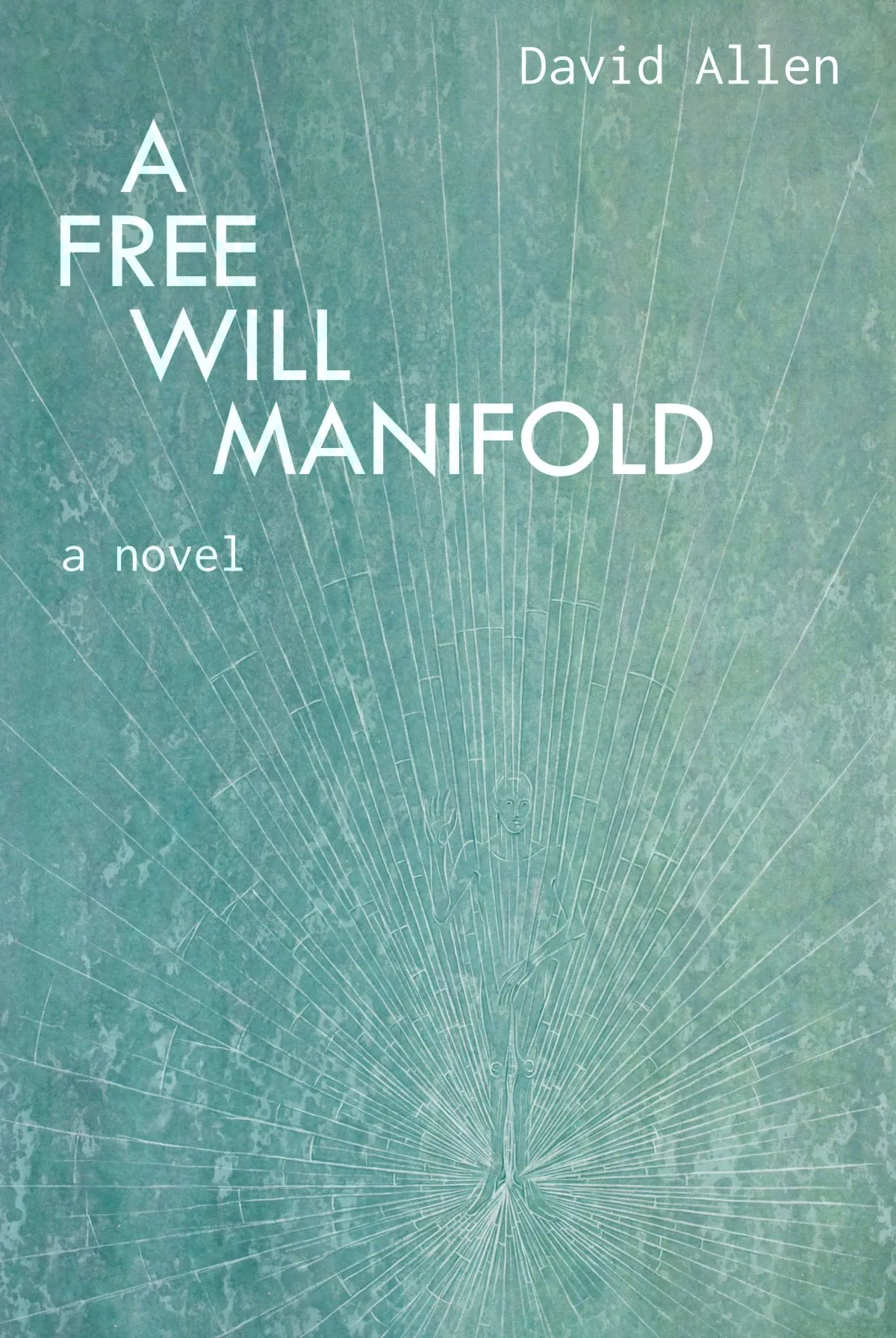
A Free Will Manifold
a novel · by David Allen
If you were given access to a library with your entire history — from birth to death — what would change?
The story
When a mathematician encounters an impossible library containing the complete record of his life, curiosity gives way to unease. The books are meticulous and intimate, cataloging not only his past, but his apparent future.
As the library’s logic begins to intrude on the world beyond its walls, friendships strain, ordinary choices grow charged, and knowledge itself starts to feel dangerous. What begins as an intellectual puzzle slowly becomes a personal and moral reckoning.
Blending mathematics, art theory, and philosophical fiction, A Free Will Manifold is a reflective novel about free will, determinism, and the fragile space between knowing and living.
But the searchers failed to remember that the chance of a man discovering his own book — or some treacherous variation of it — can be calculated as zero.
- free will
- determinism
- mathematics
- art
- memory
The characters
Though Edom—and his friend Naomi and graduate student Thomas—find themselves in a fantastical situation, they behave very much as authentic, real people.
-
Edom
The mathematician
Every choice carries moral weight for Edom, so he won’t act until he’s sure; he rehearses the future in his head, hunting for the right version. For a man who wants every fact before deciding, a record of his own life is hard to walk away from.
-
Naomi
The art historian
Naomi holds out for a life of her own choosing, down to the family she picked, and bristles at anyone who claims to know her mind better than she does. She’d rather live her life than read it, though she knows she’d never stop at one page.
-
Thomas
The grad student
Thomas’s mind is fast, and he privately suspects that speed is all it has, so he jokes before anyone can look too closely. Yet what he wants from mathematics is a question that may have no answer.
“Each of the characters is so alive… I felt as though I knew the characters, and felt slightly lost without them.” — Nicci Attfield, Reedsy Discovery
Knowing what comes next works differently on each of these minds, and slowly unsettles what it means to choose.
Acclaim
A beguiling tale of people trying to edit their lives into better versions of themselves… an entertaining read full of curiosity about the puzzles of existence.
9.50 out of 10 The BookLife Prize, 2026
- Plot/Idea10/10
- Originality10/10
- Prose9/10
- Character/Execution9/10
Allen crafts outstanding descriptions and one-liners that pop out unexpectedly, dotting the narrative with humor even as it explores weighty themes.
“Allen transforms a singular plot… into not just an entertaining storyline but also an analysis of whether free will truly exists and, if granted the opportunity, whether we should ever take over the reins of fate.”
Hard to put down, and it will keep you thinking well after the story comes to an end.

I have never read anything like this before: it is thought-provoking, spellbinding, and hugely entertaining.
“What keeps you reading is the sense of dread that permeates the writing, with a slow unraveling of mysteries.”
What readers are saying
-
“Like a Gordian Knot left uncut… a cheeky reminder, delivered with a wink, to put living ahead of understanding.”
— Amazon reader review
-
“A thoroughly clever, well-tempoed, light-hearted yet surprisingly heavy-hitting piece of literature… reminiscent of very-late-at-night philosophical musings with a group of like-minded friends (and maybe a bottle of the good stuff).”
— Goodreads reader review
-
“There's a playful quality about this book woven with characters at once recognizable yet each with the prospect of discovering something new about themselves… the enduring friendships between these characters was the connective tissue that kept me turning the pages.”
— Amazon reader review
-
“The pitch felt so Borgesian I couldn't resist… a sizable and endearing story about the meaning of life from a simple premise that Borges would have likely expedited in a dozen pages… Ultimately, David Allen manages to answer the age old question of what you would do if you had knowledge of your own future in a paradoxical yet convincing way, not a small feat. I recommend it without hesitation.”
— Amazon reader review
For readers of
A Borgesian novel of ideas — in the lineage of Jorge Luis Borges, Umberto Eco, and Paul Auster, with the cerebral pull of Donna Tartt and A. S. Byatt. For readers of recent novels of ideas such as Rachel Kushner's Creation Lake and Ian McEwan's What We Can Know, and for anyone who loves metafiction, intellectual mysteries, and fiction where mathematics, art, and philosophy collide.
“A great choice for readers who enjoy reflections on fate, choice and the small changes which change lives, and for psychologically minded readers who love a whole hearted story about real people doing unexpected things.” — Reedsy Discovery

Get your copy
Available now in three editions.
- Paperback ISBN 978-1-63991-165-3
- Hardcover ISBN 978-1-63991-172-1
- E-book ISBN 978-1-63991-166-0
Frequently asked
What is A Free Will Manifold about?
A Free Will Manifold is David Allen’s debut novel. Edom Thompson, a Boston mathematician stuck on a proof, follows a stranger’s directions to a library where his life story is shelved, the parts still to come included. He shares it with Naomi, an art historian and his closest friend, and with Thomas, the grad student he advises. It’s a funny, humane story about friendship and free will.
Who wrote A Free Will Manifold?
It was written by David Allen, the pen name of David Samuel Allen. A Free Will Manifold is his debut novel.
Was AI used to write A Free Will Manifold?
No. David Allen wrote every word of the novel himself. He was already writing it by early 2012, and most of it was finished by 2016, years before generative AI writing tools existed. The last two parts, “Ms. John” and “A Local Property,” were written around 2023, also without AI. The published text was line-edited by a human editor, Hugh Barker.
How long did it take to write A Free Will Manifold?
On and off, from about 2012 to around 2023. David Allen started the novel in Microsoft Word while working on a PhD in mathematics at Colorado State University, then moved it into LaTeX, the typesetting language mathematicians write in. He later left the program all but dissertation when he and his wife moved to France, and kept writing there, spending the spare hours of a job search on short stories and chapters. Most of the book was done by 2016. Then work picked up, their first child arrived, and the novel stalled with its last two parts unwritten. He already knew how it ended, but the weight of “Ms. John,” and of getting Naomi’s mother right, felt daunting, and being busy was, honestly, partly an excuse to avoid it. Around 2023 he decided it was silly to leave it unfinished, wrote the ending, and hired an editor, which is part of why it took until 2026 to reach readers.
Did A Free Will Manifold have a working title?
For most of its life it was called From the Book, after the mathematician Paul Erdős, who liked to say that the most elegant proofs come “straight from The Book,” an imaginary volume in which God keeps the perfect proof of every theorem. It suited a novel about a mathematician who finds his own life written down in a library.
What genre is A Free Will Manifold, and what is it similar to?
It is literary, philosophical, and speculative fiction exploring free will, determinism, mathematics, art, and memory. A Borgesian novel of ideas, it will appeal to readers of Jorge Luis Borges, Umberto Eco, Paul Auster, and Donna Tartt.
Where can I buy A Free Will Manifold?
A Free Will Manifold is available now in paperback, hardcover, and e-book. In print it is sold at Amazon (worldwide), Barnes & Noble, Bookshop.org, and Books-A-Million, and can be ordered from any bookstore or library. As an e-book it is available on Kindle, Apple Books, and Kobo.
What formats and ISBNs are available?
Paperback (ISBN 978-1-63991-165-3), hardcover (ISBN 978-1-63991-172-1), and e-book (ISBN 978-1-63991-166-0). It is a First Edition published in 2026.
What is Locrian Books?
Locrian Books is the literary imprint of F-flat Books, a small independent press based in Philadelphia, PA, publishing novels of ideas and nonfiction that reads like literature. A Free Will Manifold is its debut title.
Was A Free Will Manifold reviewed?
Yes. Kirkus Reviews gave it an Indie “GET IT” verdict, calling it “a beguiling tale of people trying to edit their lives into better versions of themselves… an entertaining read full of curiosity about the puzzles of existence.” It scored 9.50 out of 10 in The BookLife Prize Critic’s Report, with 10s for Plot/Idea and Originality, and praise for its humor and its characters. On Reedsy Discovery, Nicci Attfield wrote that it is “hard to put down, and it will keep you thinking well after the story comes to an end.” Readers have reviewed it on Amazon and Goodreads as well.